




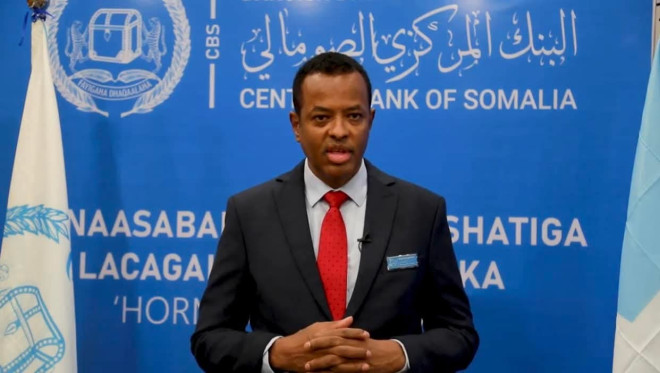
The Central Bank of Somalia has announced plans to expand the Instant Payment System (SIPS), to connect commercial banks, mobile money service providers and payment networks in the region, as part of efforts to modernize financial services and strengthen economic integration in Somalia.
The Governor of the Central Bank of Somalia, Abdirahman Mohamed Abdullahi, said that the country’s payment system has long been fragmented, with banks and mobile money service providers operating in different ways, which has hindered the integration of services and the expansion of financial services.
According to him, the National Payment System, which was implemented in 2021, has modernized large-scale interbank transfers, but does not meet the needs of everyday payments for citizens and businesses.
The Governor noted that SIPS, which was launched in January 2025 and is based on the international standard ISO 20022, enables rapid transfer of funds between institutions connected to the system. Once fully operational, it will connect all 14 commercial banks and eight mobile money and e-wallet providers.
The system is expected to facilitate payments between individuals, businesses, government agencies and companies, and will also be linked to the SOMQR QR payment system, to accelerate digital payments, especially for small businesses.
The Central Bank also plans to integrate all mobile money providers into the system, so that millions of users who rely on these services can benefit from a single unified network.
The plan also calls for Somalia to connect SIPS to the Pan-African Payment and Settlement System (PAPSS) by the end of 2026, as part of efforts to strengthen financial integration in Africa, following Somalia’s accession to the East African Community (EAC).
The Central Bank Governor said that building an efficient payment system is a strategic priority that is critical to the country’s economic growth, especially as remittances remain the backbone of income for many Somali families.