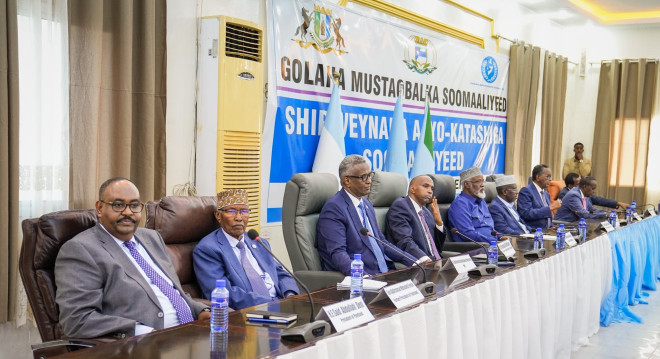
The Somali Future Council has informed the UN Security Council that dialogue efforts—involving Turkey and the “Quad” nations—failed to yield an agreement on Somalia’s electoral model.
In a letter addressed to the President of the UN Security Council, Jérôme Bonnafont, the Council stated that multiple attempts to reach a political agreement among Somali stakeholders regarding election-related disputes had proven unsuccessful.
According to the letter, the Future Council had invested significant effort in securing a political agreement, noting that the most recent process began in June 2026, with mediation efforts involving Turkey and the Quad nations.
The Council stated that it had proposed an inclusive electoral model and made concessions aimed at reaching an agreement, but that the Federal Government of Somalia had obstructed these efforts.
It noted that the breakdown of talks coincides with a period in which Somalia is facing political and constitutional tensions that have impacted relations between the Federal Government and the regional states. The Council for the Future—comprising opposition leaders and the presidents of Puntland and Jubaland—stated that Puntland and Jubaland have no relations with Mogadishu.
The Council further noted that Southwest State is in a state of armed conflict, while Galmudug and Hirshabelle are facing election-related disputes.
The Council accused the Federal Government of using military force to resolve political disputes, citing incidents that allegedly occurred in Jubaland, Mogadishu, and northern Galkayo.
The statement noted that in August, the Federal Government deployed weapons and personnel to northern Galkayo—a move the Council claimed led to armed conflict, civilian casualties, and displacement.
The Council for the Future also called on the Security Council to conduct an independent investigation into an airstrike that reportedly took place in Doolow on September 3rd.
It urged the Security Council to hold a formal session to discuss Somalia’s constitutional and political situation before the UNTMIS mandate expires on October 31, 2026, and prior to the renewal of the AUSSOM mission’s mandate. The Council also called for support for an inclusive electoral process and the establishment of an international mechanism for mediation and guarantees to resolve political disputes.
It further requested an independent mechanism to monitor the political and security situation in Somalia, particularly the electoral process and constitutional matters.
Finally, the Council stated that the situation in Somalia has reached a point requiring the Security Council to give special consideration to the future of United Nations and African Union operations in the country.