

The Somali government has stated that it will not permit its territory, ports, or airspace to be used to fuel conflicts in Yemen, Sudan, or other nations, amid an intensifying diplomatic dispute with the United Arab Emirates (UAE).
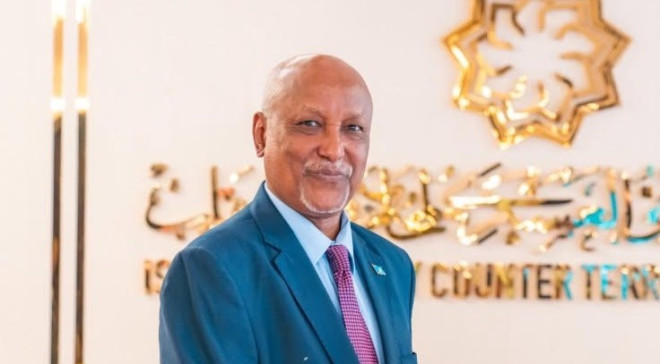
Aweys Haji Yusuf Ahmed, the National Security Advisor to the President of Somalia, stated that the Somali government’s concerns are rooted in the protection of the nation’s sovereignty, territorial integrity, the integrity of state institutions, and national security.
In a post on the platform X, he emphasized that the relationship between the two countries should be based on mutual respect, the equality of states, and non-interference in internal affairs. He noted that Somalia’s grievances should be addressed through diplomatic dialogue, security consultations, and legal processes, rather than being characterized as internal political disputes.
This statement comes in response to a declaration from the UAE Ministry of Foreign Affairs, which condemned the Somali government’s decision to expel the Emirati ambassador and recall its own ambassador from Abu Dhabi.
The UAE described Mogadishu’s move as an action that further escalates tensions and undermines the relationship between the two nations, as well as the foundations of their cooperation. The Somali government also accused the UAE of injecting internal political disputes into the relationship between the two nations—a move it stated could harm the interests of both peoples.
The diplomatic tension intensified after Somali President Hassan Sheikh Mohamud alleged on Tuesday that the UAE had established military bases in parts of Somalia and deployed forces within the country that operate outside the national security framework and without the authorization of the Federal Government.
On Thursday, the Somali government ordered the UAE ambassador to leave the country and simultaneously recalled its own ambassador from Abu Dhabi.
These measures follow Mogadishu’s decision earlier this year to annul all existing agreements with the UAE and to close its airspace to Emirati military and cargo aircraft.
President Hassan Sheikh has repeatedly stated that Somalia is open to maintaining a relationship with the UAE, provided it is built on the principles of equality, mutual respect, and the preservation of both nations’ sovereignty. In recent years, the relationship between Somalia and the United Arab Emirates (UAE) has gone through phases of both conflict and reconciliation. Tensions have particularly intensified since January, with Mogadishu accusing Abu Dhabi of interfering in its internal affairs.
This is not the first dispute to arise between the two sides. In 2018, the UAE condemned Somalia’s seizure of $9.6 million found on a UAE-owned aircraft that had landed at Mogadishu airport. At the time, Abu Dhabi stated that the funds were intended to support Somali security forces and provide training for soldiers.
Following that incident, the UAE ended its military training mission in Somalia, while also rejecting Mogadishu’s accusations that it was interfering in the country’s internal affairs.