



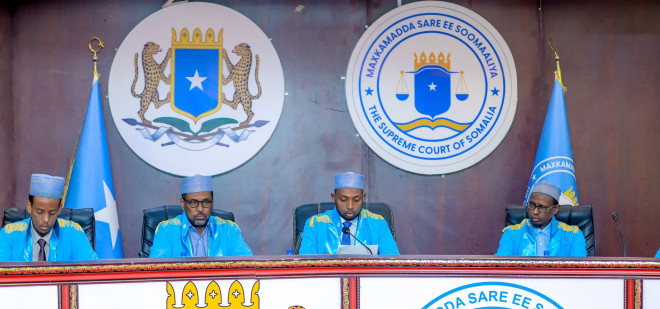
The Supreme Court of Somalia has ruled that the constitutional term limits for the Federal Parliament, the President, and the Federal Government concluded in 2026. Furthermore, the Court declared that all actions taken by these institutions following the expiration of their respective terms are neither legal nor consistent with the Constitution.
This ruling—issued on November 5, 2026, by the Constitutional Chamber of the Supreme Court, which comprises five judges—stemmed from a lawsuit filed by former Somali President Sheikh Sharif Sheikh Ahmed against the Federal Government. The case specifically challenged the procedures used to amend the 2012 Provisional Constitution and the legal consequences resulting from those amendments.
The Court noted that the lawsuit consisted of two parts: first, whether the process followed for amending the Constitution complied with Articles 132, 133, and 136 of the 2012 Constitution; and second, the legality of the actions taken following these amendments—specifically, the extension of the term limits for federal institutions.
What did the Court say regarding the constitutional amendments? The Court rejected the first part of the case, which concerned the constitutionality of the amendments made to the 2012 Provisional Constitution. The Court reasoned that Sheikh Sharif Sheikh Ahmed lacked the legal standing (*locus standi*) to initiate such a challenge, citing Article 86 of the Provisional Constitution.
However, the Court accepted the second part of the case, which addressed the legality of the consequences and measures resulting from the constitutional amendments—specifically, the extension of the terms of office for elected federal institutions.
The ruling also elaborates on the Court’s interpretation regarding constitutional amendments that alter the tenure of government institutions. It stated that when a new term duration is introduced into the Constitution, it must be explicitly specified whether or not this new duration applies to the institutions currently in office.
The Court indicated that if a new amendment remains silent on this matter, the new term duration cannot be automatically applied to the incumbent institutions; rather, their tenure remains governed by the term for which they were originally elected. Based on this, the Court determined that the constitutional term of office for federal institutions was four years, as stipulated in the 2012 Provisional Constitution, and that the 2026 amendment did not explicitly state that the new term would apply to the institutions then in office.
The Court ruled that the term of office for both houses of the Federal Parliament ended on April 14, 2026, while the term of the President of the Republic ended on May 15, 2026.
Furthermore, it stated that the term of the Federal Government—which derives its mandate from the two houses of Parliament—also ended on April 14, 2026, given that Parliament holds the authority to grant confidence to and oversee the Government.
The decision further added that these institutions lacked the authority to take actions based on their constitutional or legal powers beyond the expiration of their respective terms.
The Court also ruled that any actions taken by these institutions after those dates are inconsistent with the Constitution and the law, and are therefore null and void. Another significant point in the ruling is the Court’s statement that the Federal Government is the sole authority vested with the power to manage the transition period; however, this authority is strictly limited to the execution of routine, day-to-day administrative functions.
It clarified that the Government may not take any actions that extend beyond these routine daily operations.
The Supreme Court has directed all parties involved in the electoral process to reach an agreement—within 30 days—on an inclusive and implementable electoral framework.
It further mandated that the election be held within a period of 90 days.
This ruling was issued in Mogadishu on November 5, 2026, and was signed by five judges, led by Justice Salah Sheikh Ibrahim Dhiblawe.